

The Complete Guide to Manufactured Homes for Sale in Fort Worth, TX
Understanding Your Options: Manufactured vs Modular Homes
If you are shopping for manufactured homes Fort Worth TX, you can expect base prices around $50–$80 per square foot, with most homes move-in ready in roughly 6–12 weeks after site preparation begins. Buyers typically place a home on private land they own or lease a lot in a land-lease community, both common options throughout Tarrant County and surrounding North Texas. Modern factory construction keeps pricing lower than site-built housing while still delivering open floorplans, energy-efficient features, and HUD-regulated structural standards.
When navigating the North Texas housing market, terminology matters. Many people still use the phrase “mobile home” to describe any home built off-site. However, the term “mobile home” legally refers only to factory-built housing constructed before June 15, 1976. On that date, the United States Department of Housing and Urban Development established the National Manufactured Housing Construction and Safety Standards Act, commonly known as the HUD Code.
Modern manufactured homes are constructed entirely in climate-controlled factories under stringent HUD oversight. These standards govern structural strength, fire safety, plumbing, heating, electrical systems, and overall energy performance. Because factory environments protect materials from adverse weather, the framing, subflooring, and insulation remain dry and undamaged during construction. For an overview of how these homes are built and delivered, the manufactured housing process covers factory fabrication, transport, and installation.
Modular homes share this controlled manufacturing environment, but they are built to meet the same local, municipal, and state building codes (such as the International Residential Code or IRC) as traditional on-site homes.
| Feature | Manufactured Homes | Modular Homes | Traditional Site-Built Homes |
|---|---|---|---|
| Governing Building Code | Federal HUD Code | State/Local IRC Standards | State/Local IRC Standards |
| Average Cost Per Sq. Ft. | $50 – $80 | $90 – $150 | $150 – $200+ |
| Construction Location | Off-site enclosed factory | Off-site enclosed factory | On-site outdoors |
| Foundation Types | Pier & beam, runners, engineered slab | Permanent slab, crawlspace, basement | Permanent slab, crawlspace, basement |
| Property Classification | Personal property or real property | Real property | Real property |
| Typical Build Timeline | 2 to 6 weeks in factory | 6 to 10 weeks in factory | 6 to 12+ months |
Why Buyers Choose Manufactured Homes Fort Worth TX
For thousands of families across North Texas, factory-built housing provides an exceptional balance of affordability, style, and build quality. In Texas, approximately 20% of all new single-family homes sold fall into the manufactured housing category, driven by high demand in rapidly growing metropolitan areas like DFW.
A major driver is cost efficiency. Traditional construction involves weather delays, material waste, subcontractor scheduling bottlenecks, and rising labor expenses. In contrast, factory construction leverages bulk purchasing power and assembly-line precision. These savings pass directly to you, keeping purchase prices significantly lower without sacrificing structural integrity.
Today’s designs feature open-concept living rooms, chef-inspired kitchens with large islands, walk-in closets, spa-like primary bathrooms, and built-in energy-saving technologies like double-pane Low-E windows and high-efficiency heat pumps. You can explore our modern manufactured homes to see how far factory-built architecture has come.
Modular vs Manufactured Structural Differences
While both options leave the factory largely complete, their structural design addresses different regulatory frameworks:
- Chassis and Transport: Manufactured homes are constructed on a permanent steel chassis (I-beams) that supports the structure during transit and serves as an integral part of the home’s foundation system. Modular homes are typically built on removable transport frames or integrated structural steel frames designed to be hoisted by crane onto a permanent concrete foundation.
- Zoning and Placement: Because modular homes comply with the IRC, local municipalities treat them identically to traditional custom homes. They can be placed in virtually any residential zoning district. Manufactured homes must comply with specific local zoning overlays and municipal ordinances that dictate where HUD-code homes can be installed.
- Long-Term Equity: When permanently affixed to private land with an engineered foundation, manufactured homes can appreciate similarly to site-built properties, especially in high-growth North Texas corridors. Modular homes automatically appraise and appreciate as traditional real estate from day one.
Pricing, Land Placement, and Zoning Laws in Tarrant County
Navigating land placement requires understanding the intersection between local municipal codes, county rules, and neighborhood deed restrictions. In Fort Worth and unincorporated Tarrant County, regulations protect property values while ensuring all electrical, plumbing, and structural installations meet life-safety benchmarks.
Site Selection and Permitting for Manufactured Homes Fort Worth TX
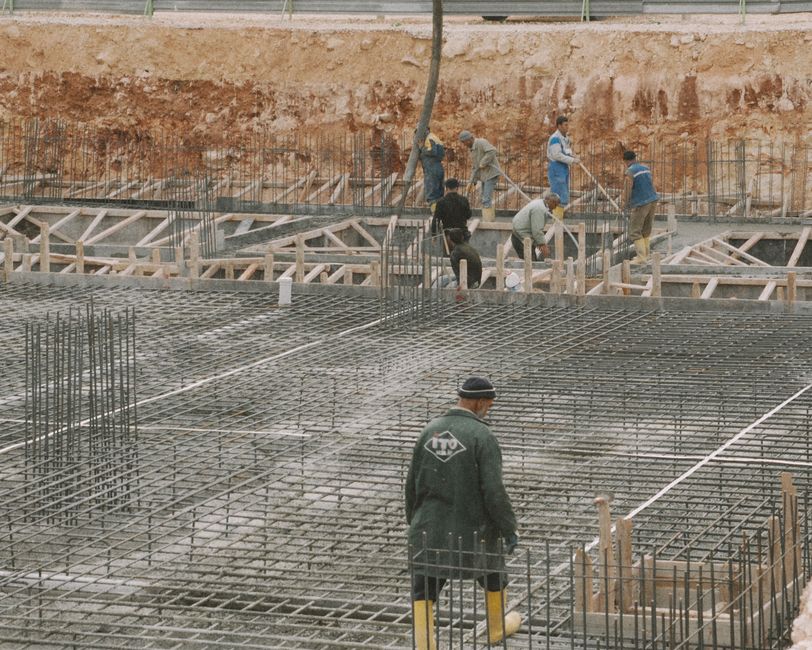
Before purchasing land or signing a home contract, verify the exact zoning classification of your target parcel. If your land lies within Fort Worth city limits, single-family zoning districts (like A-5 or R-1) generally do not permit HUD-code manufactured homes unless the parcel is specifically zoned for manufactured housing (such as “MH” zoning districts) or designated as a legal non-conforming lot.
If your property sits in unincorporated areas of Tarrant, Parker, Wise, or Johnson counties, placement is generally more flexible. However, you must still address essential site preparation requirements:
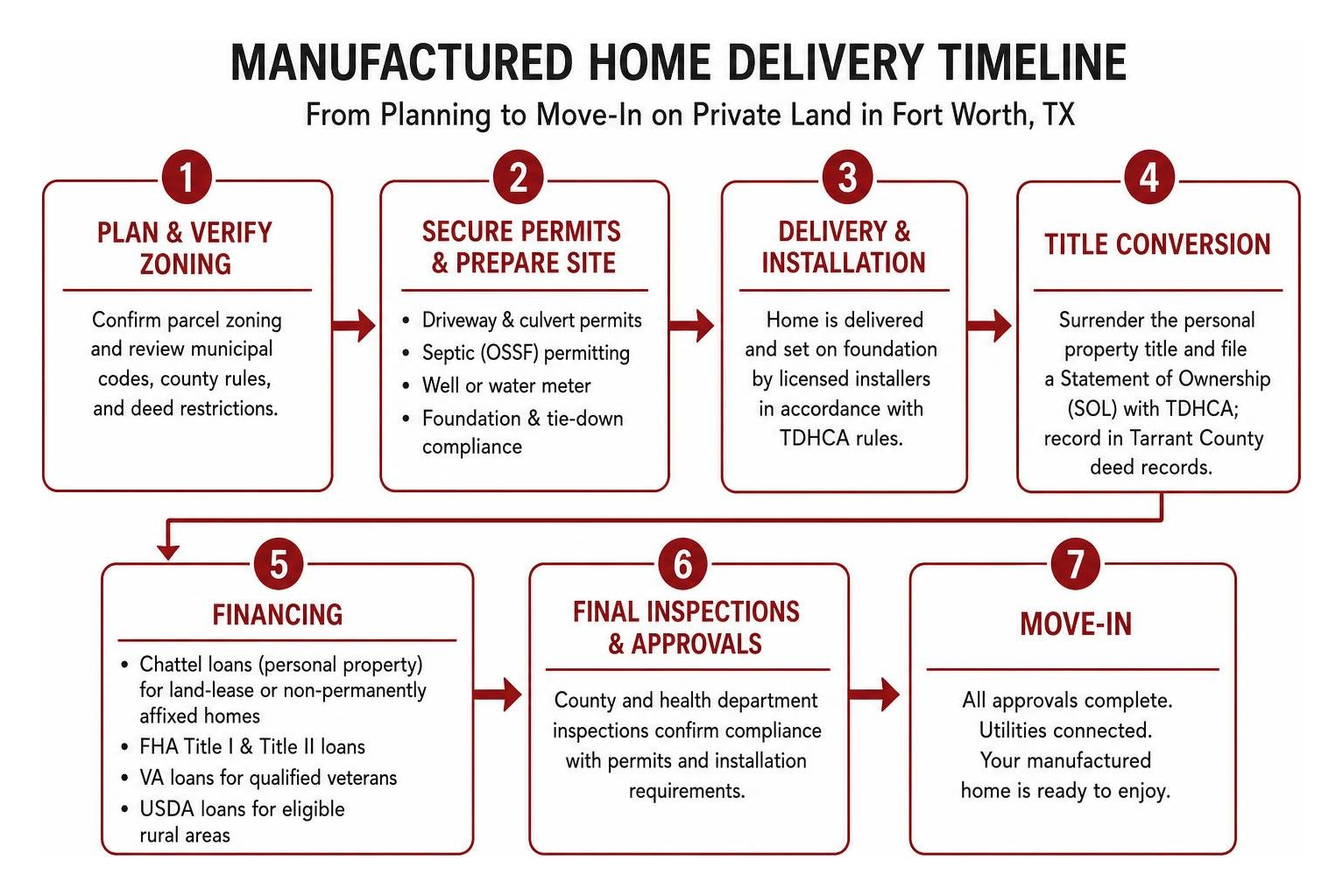
- Driveway and Culvert Permits: Required by county road departments to ensure proper drainage along public right-of-ways.
- Septic (OSSF) Permitting: If city sewer is unavailable, an authorized site evaluator must perform a soil percolation test and design an on-site sewage facility permitted through Tarrant County Public Health.
- Well or Water Meter Installation: Connection fees for municipal water lines or drilling permits for private water wells.
- Foundation and Tie-Down Compliance: Texas requires all manufactured home installations to be certified by licensed installers in accordance with the Texas Department of Housing and Community Affairs (TDHCA) Manufactured Housing Division rules.
- Title Conversion (Statement of Ownership): To classify your home as real property for tax and mortgage benefits, you must surrender the personal property title and file a Statement of Ownership (SOL) with the TDHCA, recording it in the Tarrant County deed records.
Land-Lease Communities vs Private Land Ownership
Buyers in the Fort Worth area generally select one of two property arrangements:
- Land-Lease Communities: In a dedicated community or park, you purchase the manufactured home and pay a monthly lot lease for the land it occupies. Average lot rent in the Fort Worth area ranges from $400 to $700 per month. This fee typically includes community amenities (such as swimming pools, playgrounds, gated access, and clubhouses), lawn maintenance, and basic utility connections. It requires a lower upfront capital investment since you do not need to buy acreage.
- Private Land Placement: Purchasing private land (ranging from suburban lots to multi-acre parcels in outlying areas like Haslet, Azle, Weatherford, or Burleson) requires higher initial financing but builds equity in both the home and the underlying land. You avoid monthly lot rent, gain privacy, and retain full control over your property improvements.
Financing and Weather Protection for Manufactured Homes Fort Worth TX
Securing a mortgage for factory-built housing is a straightforward process when working with lenders specialized in the industry. The financing structure largely depends on whether the home is classified as personal property (chattel) or real estate.
Loan Programs and Insurance Solutions
- Chattel Loans: If you place a home in a land-lease community or choose not to attach your home permanently to your private land, you will use a personal property (chattel) loan. These loans feature faster closing times, though interest rates and down payment requirements are typically slightly higher than traditional mortgages.
- FHA Title I and Title II Loans: Backed by the Federal Housing Administration, Title I loans finance the home alone or the home plus a lot. Title II loans offer 30-year fixed terms with down payments as low as 3.5% when the home and land are purchased together and permanently affixed to an engineered foundation.
- VA and USDA Rural Development Loans: Qualified military veterans can access zero-down-payment options through VA-backed manufactured home loans. In eligible rural boundaries surrounding Fort Worth, USDA loans provide 100% financing for qualified low-to-moderate-income buyers.
- Conventional Conforming Mortgages: Programs like Fannie Mae MH Advantage and Freddie Mac Home Possible allow conventional financing with down payments as low as 3% on eligible modern multi-section homes.
We guide you through the pre-qualification and approval steps through our dedicated financing support.
Delivery and Move-In Timeline
Moving into a factory-built home is significantly faster than waiting for a custom on-site build. Here is what you can expect during the process:
- Floorplan Selection and Customization (Weeks 1–2): Finalizing your layout, interior finishes, cabinetry, and exterior design.
- Permitting and Site Preparation (Weeks 2–6): Grading the homesite, pouring footers or runners, clearing trees, and installing underground utility connections while the home is being constructed.
- Factory Fabrication (Weeks 3–7): Building the home inside the precision-controlled manufacturing facility.
- Transportation and Blocking/Leveling (Week 8): Licensed transport teams deliver the sections to your Fort Worth site, where certified installers level, secure, and anchor the structure.
- Trim-Out, Utility Connections, and TDHCA Inspection (Weeks 9–10): Joining the rooflines and marriage walls, connecting plumbing lines and electrical panels, testing HVAC systems, and receiving final habitability certificates.
You can view our current inventory of ready homes to explore layouts that can significantly shorten this delivery timeframe.
Avoiding Common Pitfalls and Ensuring Long-Term Value
Purchasing a home is one of the largest financial decisions you will ever make. To ensure a seamless experience in the North Texas market, keep these best practices in mind:
- Demand Turnkey Pricing: Some dealers advertise base home prices that omit necessary costs like freight delivery, site preparation, crane rentals, concrete work, air conditioning unit installation, steps, skirting, and utility hookups. At Red River Modular Homes, our Texas-owned and Texas-operated team guarantees transparent pricing with no hidden costs and provides weekly project updates.
- Verify Wind and Climate Zones: Fort Worth is located in HUD Wind Zone I and Thermal Zone 2. However, due to severe spring storms, hail, and intense summer heat waves in North Texas, upgrading to higher-grade insulation, architectural shingles, and heavy-duty storm anchoring systems provides long-term energy savings and storm protection.
- Perform Professional Soil Testing: The expansive clay soils common throughout Tarrant and surrounding counties shrink and swell with seasonal moisture changes. Ensure your site installer uses appropriate foundation designs, such as poured concrete runners or engineered slabs, to prevent unlevel floors and cosmetic drywall cracks over time.
- Understand Your Warranty Coverage: Always verify what is covered by the manufacturer’s warranty, the installer’s structural warranty, and appliance protections.
If you are ready to explore your options or have specific site questions, contact our team directly.
Frequently Asked Questions About Manufactured Homes in Fort Worth
How do property taxes work for manufactured homes in Fort Worth?
If your home is located in a land-lease community or titled as personal property, you pay personal property tax on the home structure to the Tarrant Appraisal District (TAD), while the park owner pays real estate taxes on the land.
When you own the land and file a Statement of Ownership (SOL) with the TDHCA converting the home to real property, the house and land are assessed together as a single real estate account. This allows you to apply for standard Texas property tax relief, including the General Residential Homestead Exemption, Senior Exemption, and Disabled Veteran exemptions.
How long does it take from purchase to move-in?
The average timeline ranges from 6 to 12 weeks from contract signing to final occupancy. If you choose an in-stock, move-in-ready model and your private land already has water, sewer, and electric services in place, move-in can occur in as few as 3 to 4 weeks. Custom factory builds with complex land preparation typically take between 8 and 14 weeks.
Can manufactured homes withstand North Texas tornadoes and severe weather?
Yes. Since the implementation of updated HUD standards in 1994, manufactured homes are engineered to resist high wind loads. In North Texas, homes are secured with heavy-gauge steel ground anchors and high-tensile strapping designed to resist lateral wind shear and uplift forces. While no residential wood-frame building is completely immune to direct-hit severe tornadoes, proper anchoring, impact-resistant roofing, and durable fiber-cement siding provide robust protection against regional high winds, hail, and severe thunderstorms.
Conclusion
The North Texas housing landscape continues to evolve, but the demand for well-built, attainable housing remains constant. Modern factory-built housing combines engineering precision, rapid build times, and high energy efficiency to deliver exceptional value for homeowners across Tarrant County.
Whether you plan to place a home on family acreage in the countryside or settle into a vibrant community, our team at Red River Modular Homes provides transparent guidance, quality construction, and end-to-end support to help you achieve your homeownership goals.


